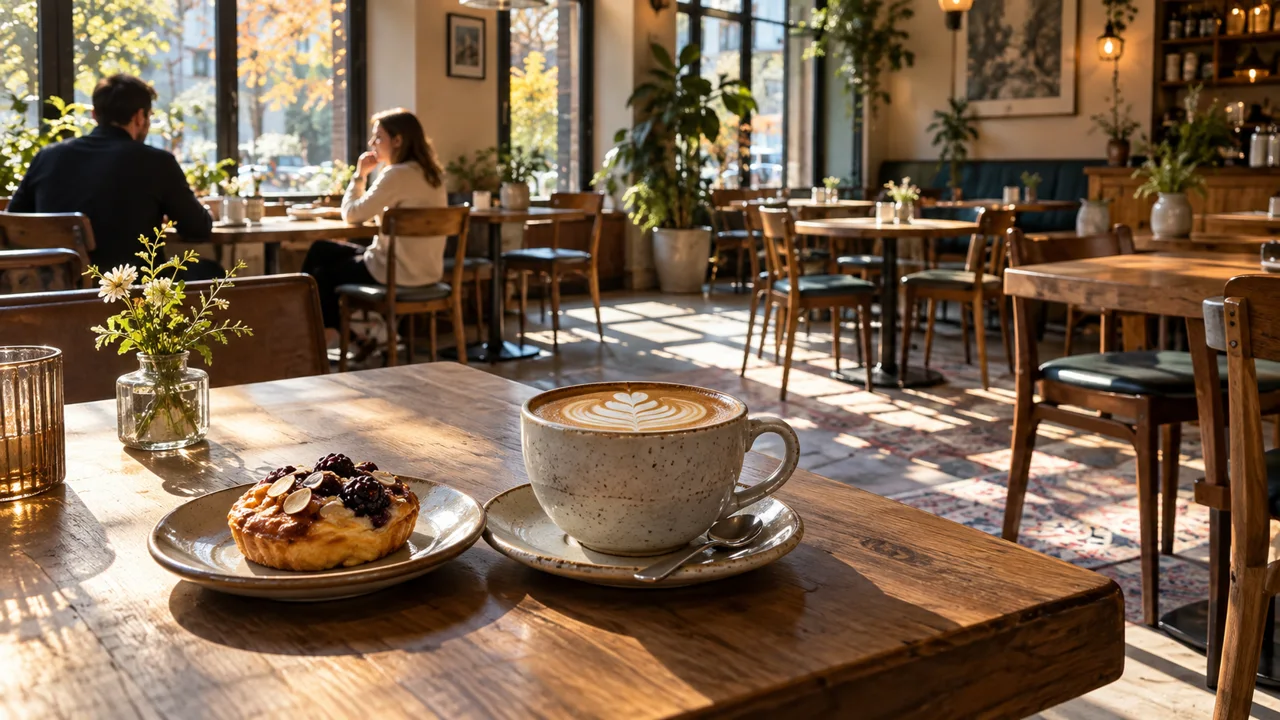
The lunch rush ends. The tables empty. Your team is still on shift, and the next order feels a long way off.
An off-peak offer can be worth testing, but “20% off everything” is not a strategy on its own. Start by defining the hours you want to fill, the customers who could realistically visit and what an additional order would leave after its costs.
A value offer is worth testing, not assuming
In OpenTable's 2026 Australian Dining Trends Report, 43% of respondents wanted more happy-hour and value promotions. The underlying survey covered 1,521 Australian respondents in September 2025. That signals interest; it does not establish how many extra customers a particular cafe promotion will attract.
The useful response is a bounded experiment, not a permanent discount across your busiest and quietest hours.
Choose one quiet window
Look at several comparable weeks and select a specific gap. “Weekdays are slow” is too broad. “Tuesday to Thursday, 2–4 pm” gives you something you can measure and explain.
Check that the apparent gap is not caused by inconsistent opening hours, a missing menu online or a kitchen that is already closing. Advertising availability your staff cannot deliver creates a different problem.
Then identify a plausible audience. Nearby office workers might need an afternoon break. Local residents might value an early dinner. Pick one group and make the offer fit its routine rather than guessing that everyone wants a discount.
Make the offer easy to understand and fulfil
A limited coffee-and-snack pairing, a small set menu or an existing dish with a low-cost addition can be easier to cost than an open-ended discount.
Keep the terms visible: eligible items, dates, times, collection or dine-in conditions, and any genuine quantity limit. Avoid complicated exceptions that require the cashier to explain the promotion to every customer.
The offer should also fit spare capacity. An item that monopolises the one station preparing dinner may not suit the quiet period as well as sales totals suggest.
Calculate the sales you actually need
Here is an illustrative A$ example, excluding tax.
Suppose an off-peak combo sells for $9 and has $4 in direct variable costs. Each additional combo contributes $5 before fixed costs. If promotion and extra staffing cost $100 for the test, you need 20 genuinely additional combos to recover that spend.
Now add an important complication. Suppose 15 customers would otherwise have bought the same combination for $11. Selling it to them for $9 reduces contribution by $30 in total.
Your test now needs $130 of additional contribution, or 26 additional combos, just to offset the campaign cost and that displaced full-price spending.
This is why redemptions alone cannot tell you whether an offer worked.
Separate extra demand from shifted demand
Track sales in the promoted window and nearby time slots. If afternoon orders rise but lunchtime orders fall by the same amount, investigate whether you have moved demand rather than created it.
Also review basket value, contribution, preparation time and customer complaints. A sensible comparison might use similar weekdays before and during the test, with notes for rain, public holidays or local events. It is a practical signal, not a controlled proof of impact.
Use your own in-store signage, website and appropriately consented customer communications. Start with a small audience so you can notice operational problems before expanding.
Decide what happens when the test ends
Keep the offer only if its contribution and service impact make sense. You can change the items, narrow the hours or stop entirely. A promotion does not need to become permanent to provide useful learning.
Try this next: write one offer on a single page: target hours, audience, items, direct costs, test budget and the number of additional orders required. If staff cannot explain it easily, simplify it before launch.
Write the offer before you launch it
- Hours: Tuesday to Thursday, 2–4 pm, for the stated trial dates.
- Offer: name the eligible drink and snack, with the complete customer-facing price.
- Capacity: identify who prepares and serves it.
- Decision: compare additional contribution with the test cost and displaced full-price sales.
This is a planning example. Replace the items, times and conditions with ones your cafe can honour.
Put your next offer under your own brand
Review BizAppMaker’s available features when planning a branded website and app. Bring the offer you have costed, including its hours and exclusions, and confirm how it can be represented before promoting it.
See what a branded app looks like for cafes, or try the live app demo.