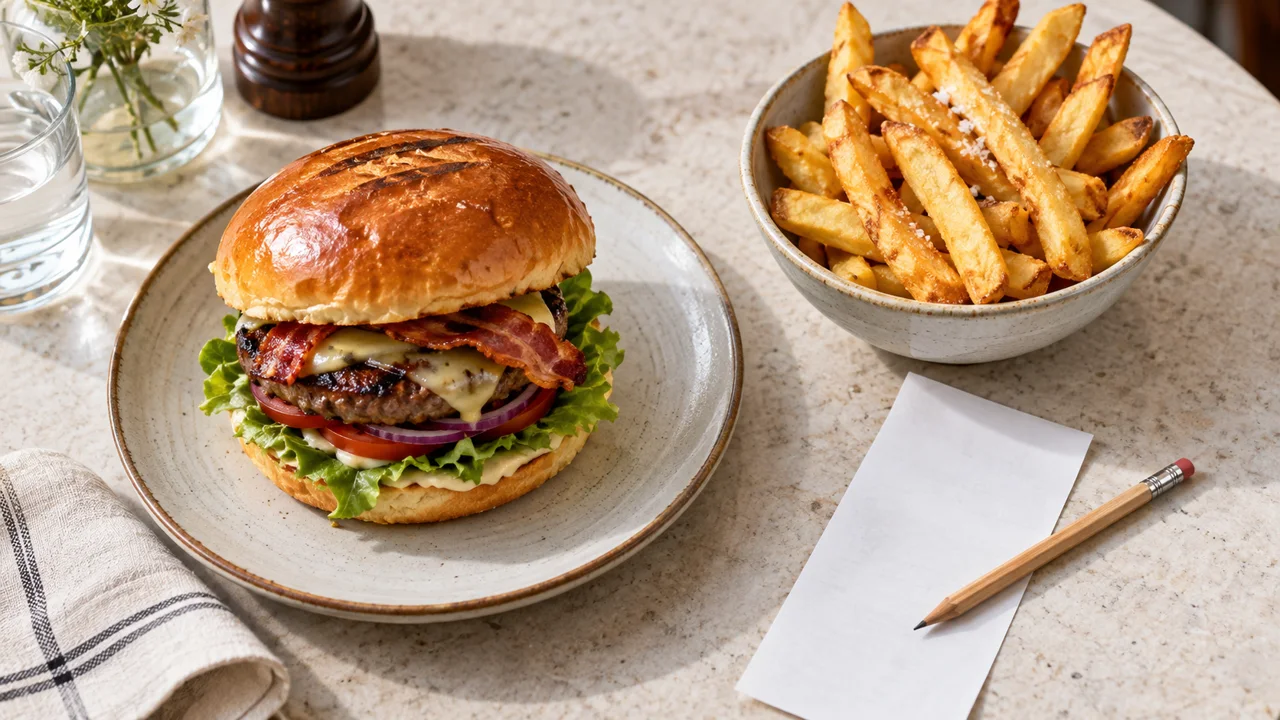
“20% off” is easy to advertise. It is also easy to approve before calculating how much extra food you need to sell to recover the discount.
A meal deal may preserve more contribution, but it is not automatically better. The answer depends on what customers would have bought without the promotion, the extra cost of the bundle and whether the kitchen can handle the volume.
Value gets attention; economics decide what to keep
The US National Restaurant Association's 2025 off-premises report summary says more than 80% of consumers use deals such as combinations, buy-one-get-one offers or real-time specials. It does not establish which deal leaves a restaurant with the most profit.
Use customer interest to choose what to test, then use your own costs to judge the result.
Compare the same starting point
Consider this illustrative A$ example, excluding tax. A burger normally sells for $18 with $7 in direct variable costs. A side adds $1.20 in direct variable costs. The normal combined selling price is $23.
For simplicity, the table excludes fixed overheads and payment-processing differences. Include those in your actual costing where relevant.
| Option | Revenue | Listed variable costs | Contribution |
|---|---|---|---|
| Full-price burger | $18.00 | $7.00 | $11.00 |
| Burger with 20% discount | $14.40 | $7.00 | $7.40 |
| Promotional burger-and-side bundle | $21.00 | $8.20 | $12.80 |
| Same bundle at normal price | $23.00 | $8.20 | $14.80 |
The percentage discount removes $3.60 from contribution on each burger. The promotional bundle contributes $1.80 more than a burger alone, but $2 less than selling the same bundle at full price.
The comparison customer matters.
Work out how much extra volume a discount needs
One hundred full-price burgers contribute $1,100 in the example. At $7.40 contribution per discounted burger, you need 149 burgers to reach at least that amount.
That is approximately 49% more units, not 20%.
It also means more preparation, packaging and service. If that extra volume creates additional labour costs, the recovery target rises further. A discount that fills spare capacity has different consequences from one that overloads your busiest service.
Use this formula for a simple comparison:
Required promotional units = original total contribution ÷ promotional contribution per unit.
Round up, and add any campaign-specific costs before deciding the target.
Check whether a bundle adds a purchase or discounts one
A $21 bundle may work well when customers would otherwise buy only the $18 burger. It is less attractive when those customers would already have bought the $23 combination.
Look at changes in the mix of purchases, not just the number of bundles sold. Review average contribution per order alongside basket value. A higher basket is not automatically a more profitable basket.
Avoid using a bundle as a reason to prepare extra stock blindly. Choose items whose supply and preparation you can manage, then watch unsold stock as part of the test cost.
Make the offer clear enough to trust
State exactly which products qualify, what substitutions cost and when the promotion is available. A saving should reflect a genuine comparison price, not an inflated number created for the promotion.
For Australian consumers, follow the ACCC's price-display guidance when presenting total prices and applicable charges. Other markets have their own requirements, so do not assume one promotional template covers every jurisdiction.
Decide before the campaign what success means
Choose a contribution target, a workable order volume and a maximum promotional cost. Then review completed sales, refunds and operational pressure across comparable services.
Try this next: cost one bundle and one discount against both a single-item buyer and a full-price bundle buyer. Choose the test that improves the economics for the customers you are actually likely to attract.
Give a properly costed offer a clear home
Explore BizAppMaker’s features for a branded app and website. Bring the products, prices and promotion terms you have costed, and confirm how the available tools can represent them.
See what a branded app looks like for restaurants, or try the live app demo.