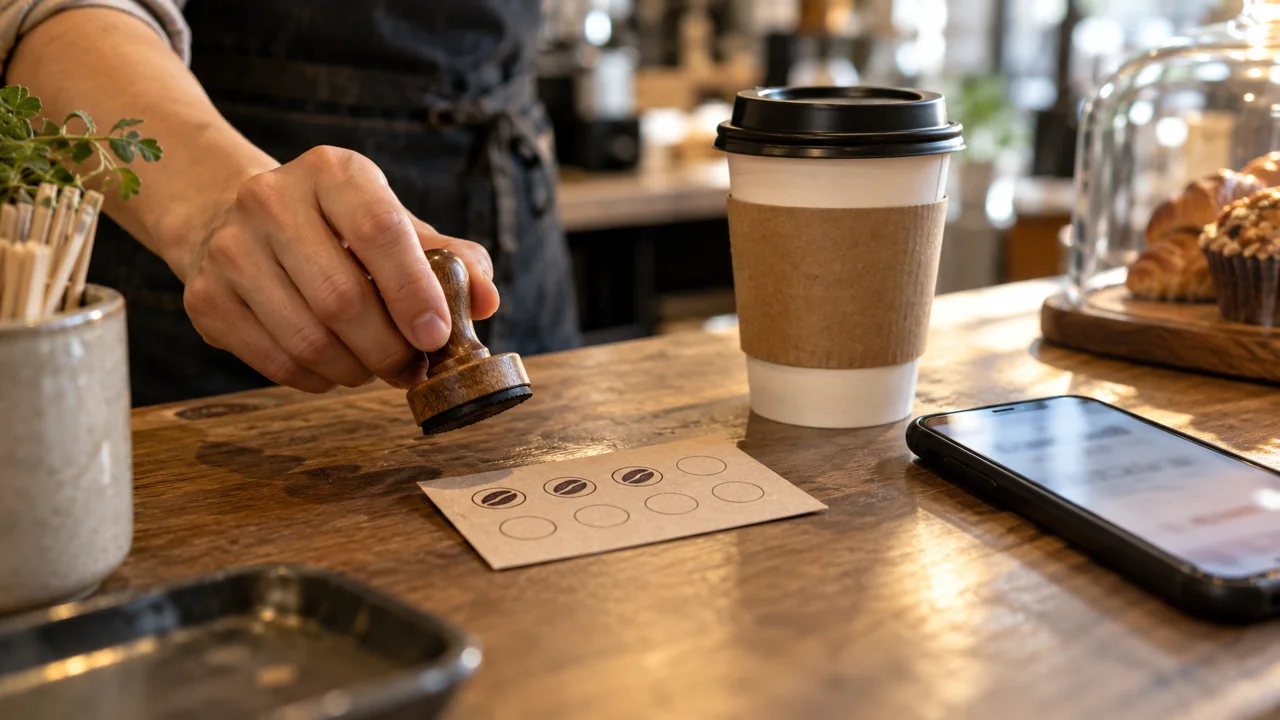
A loyalty programme should be easy to explain while a customer is waiting for coffee. If the rules need a long conversation, your design deserves another look.
The right choice is not automatically points, stamps or a free item. Choose the behaviour you want to encourage, then make the reward understandable, attainable and affordable.
Start with behaviour, not software
Square's 2026 Australian Local Economy Report found that 36% of surveyed consumers said a loyalty programme or app would make them more likely to frequent a local business. It measures stated preference across local businesses, not the effectiveness of any particular reward design.
Before selecting a format, decide whether you want more frequent visits, an additional item in the basket or renewed attention from occasional guests. These goals can call for different mechanics.
Three formats, three trade-offs
| Format | A practical use | What to watch |
|---|---|---|
| Stamps | Repeated purchases with a fairly consistent basket | High- and low-value purchases may earn the same reward |
| Points | Different basket sizes and a wider menu | Customers may struggle to understand the real value |
| Instant reward | A first trial, a particular visit or a limited campaign | You may subsidise a purchase that would happen anyway |
For a stamps offer, state exactly which purchases qualify and when the reward becomes available. For points, make the conversion understandable in ordinary money or products. For an instant reward, explain eligibility before checkout.
Do not add tiers simply because your software supports them. Every rule creates another thing to explain, maintain and resolve when a customer asks a question.
Cost the whole cycle, not just the free coffee
Consider an illustrative A$ example, excluding tax: a coffee sells for $5 and has $2 in direct variable costs. A customer buys nine and receives the tenth free.
Across those ten coffees, the cafe receives $45 and incurs $20 in the listed costs, leaving $25 before fixed costs. Ten full-price coffees would leave $30.
The free coffee costs $2 to produce, but the comparison also involves a potential $5 sale. Neither number alone tells you whether the programme is worthwhile. The important question is whether the reward creates additional profitable visits or prevents enough lost visits to justify its cost.
Use your actual redemption behaviour rather than assuming every reward is redeemed or none are. Account for refunds and voided purchases consistently so the balance reflects what really happened.
Test whether the reward feels reachable
Ask a customer to explain the programme back to you. Can they tell what earns a reward, what it is worth and how to use it?
Consider the natural buying cycle too. A person who visits monthly has a different journey from someone who visits every weekday. A distant reward may suit one group poorly even when its headline value sounds generous.
A useful pilot can be small. Keep the rules stable long enough to observe a full reward cycle and avoid changing the promise halfway through without clear notice and appropriate treatment of existing balances.
Make redemption work for staff
Walk through the exceptions before launch: a returned purchase, a partially refunded order, a customer without their phone and a reward used during a busy service.
Write a short staff procedure. Decide who can correct mistakes and what evidence they need. Ensure the process does not depend on everyone remembering a verbal explanation from last week.
Digital records can be useful, but do not confuse reward membership with permission to send every form of marketing. Check the consent process separately; ACMA's Australian guidance distinguishes marketing permission from merely having someone's contact details.
Measure visits and contribution, not just sign-ups
Track enrolment, repeat visits, rewards issued, rewards redeemed and contribution after reward costs. Compare customers over equivalent periods and remember that people who enrol may already be your most loyal guests.
Try this next: choose one simple mechanic, calculate a complete reward cycle and trial it with clear terms. Expand after you understand the economics and the staff workload.
Choose a branded experience that fits your reward
BizAppMaker’s branded app includes stamp cards, points, membership tiers and rewards that customers redeem as coupons in the app. For food and drink businesses, a customer can collect one stamp per day. Review BizAppMaker’s loyalty features with your reward rules in hand, and start with the simplest version your team can explain at the counter.
Take a look at how BizAppMaker works for cafes, or try the live app demo.