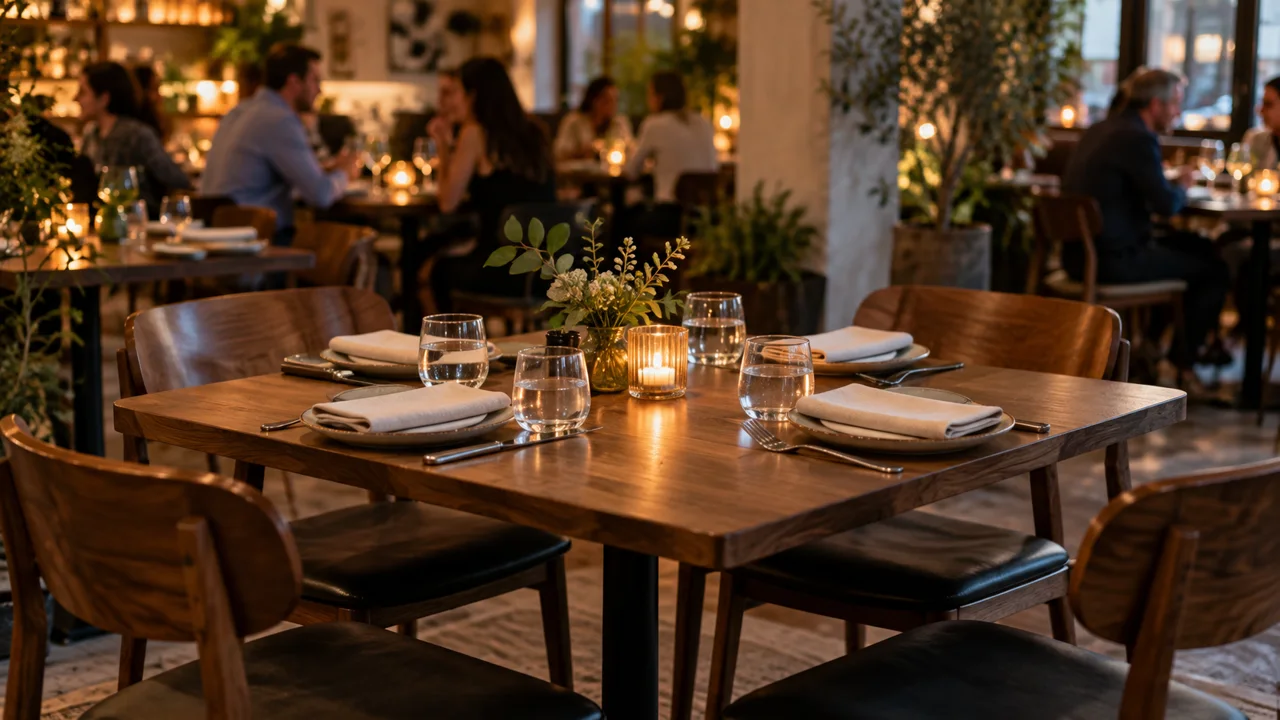
A table for four does not arrive. You held the seats, planned the service and may have turned away another booking.
The frustration is immediate. The financial impact needs a more careful calculation. Start by separating no-shows, late cancellations and seats you successfully resold. They are related problems, but not the same outcome.
Use a benchmark that measures the right thing
The Resos No-Show Index 2026 records a 1.41% no-show rate in its Australian sample of 251,804 eligible reservations across 213 restaurants, covering August 2025 to July 2026. It uses recorded booking outcomes, excludes walk-ins and reports cancellations separately. It is not a random sample of every Australian restaurant, and recording practices can affect the result.
Do not compare that directly with a survey asking whether diners have ever skipped a reservation. One measures bookings; the other measures people admitting a past behaviour.
Define your own records consistently
Decide how staff distinguish attended bookings, no-shows and cancellations. If a guest arrives late, record the final outcome rather than leaving the booking marked as missed.
For a comparable booking-level rate, use recorded no-shows divided by attended bookings plus no-shows in the selected period. Track cancellations and walk-ins separately, and allow enough time for staff to finalise outcomes.
Review both reservations and covers. One missed booking for ten people creates a different exposure from one missed booking for two, even though each is one entry in the diary.
Calculate revenue at risk, not imaginary profit
Consider this hypothetical A$ example, excluding tax:
| Measure | Illustration |
|---|---|
| Attended bookings plus no-shows | 1,000 |
| Recorded no-show bookings | 25 |
| Recorded no-show rate | 2.5% |
| Covers attached to those no-shows | 100 |
| Covers subsequently replaced | 40 |
| Unfilled covers | 60 |
At an assumed $45 spend per cover, those 60 unfilled seats represent $2,700 of revenue at risk, not $2,700 of lost profit.
If serving each cover would have added $18 in avoidable variable costs, the corresponding contribution opportunity is 60 × ($45 − $18) = $1,620. Treat this as an estimate of what might have been earned, not guaranteed lost sales.
Account separately for actual wasted preparation, unavoidable staffing and any retained payments. Avoid counting the same cost twice. The realistic counterfactual also matters: could you actually have sold those seats to someone else at that time?
Choose a response that matches the exposure
Start with clear confirmation details and an easy way to cancel. A guest should be able to see the date, time, party size and the applicable policy without hunting through several messages.
Check which reminders your current system genuinely sends, what happens when delivery fails and whether cancellations release capacity promptly. Do not assume a reminder solves every missed booking.
For high-exposure services or large groups, consider whether deposits, reconfirmation or another safeguard suit your business. Review applicable consumer law, payment permissions and clear disclosure before introducing fees. This article is an operating framework, not legal advice or a recommendation for a specific penalty.
The Resos study itself cautions against interpreting differences between protected and unprotected bookings as proof that the payment feature caused the outcome. Keep your own expectations equally measured.
Review the policy beyond no-show rate
A lower no-show rate is not the only result to watch. Look at completed bookings, timely cancellations, replacement covers, complaints and staff workload.
A policy that discourages valid bookings can change the denominator and make one percentage appear better while reducing business overall.
Try this next: reconcile one month of booking outcomes, calculate unfilled covers and identify the services with the greatest exposure. Design the smallest proportionate change that addresses that problem.
Make the next step clear on your own website
Your own website and app can make the next step clear. BizAppMaker’s restaurant and cafe apps can take table bookings with the date, time and party size, send booking confirmation and reminder emails, and let guests cancel from the app so the time becomes available again. You set how many bookings you accept at each time. Table bookings do not take deposits or charge no-show fees, so if your exposure calls for a deposit, use a process designed for it. Discuss your booking needs with BizAppMaker.
Take a look at how BizAppMaker works for restaurants, or try the live app demo.