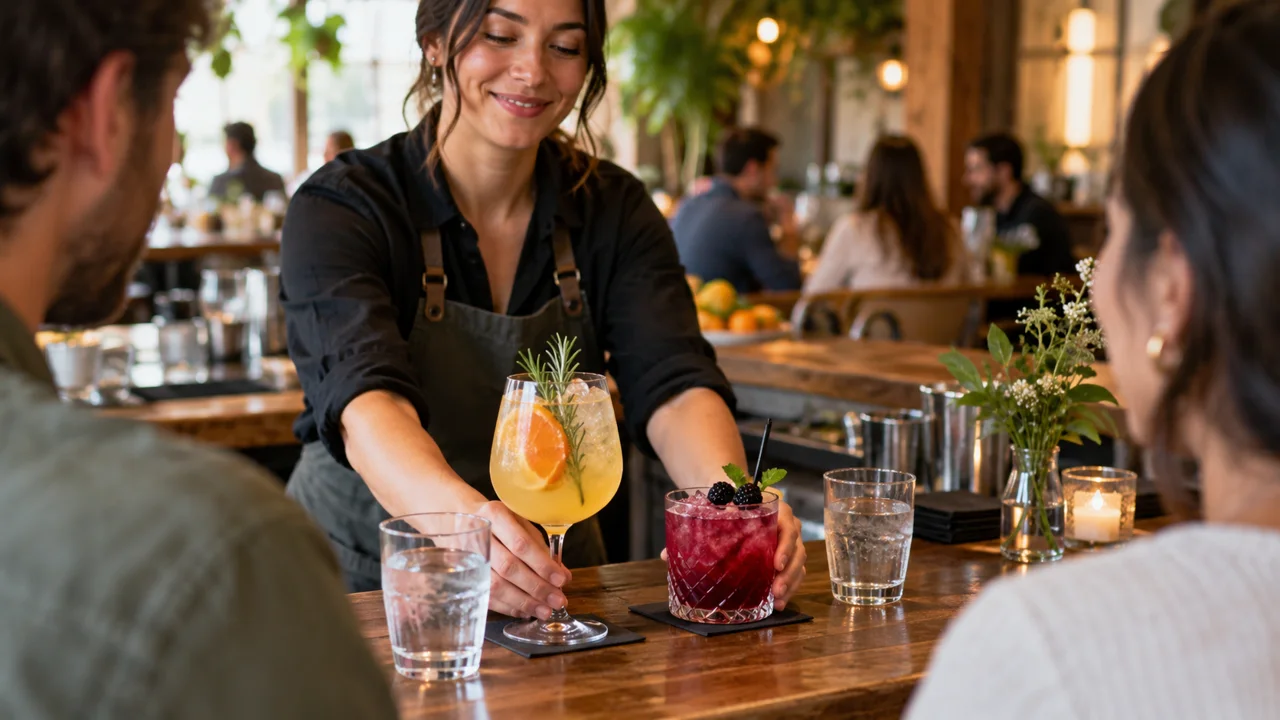
A table orders drinks. One guest asks what is available without alcohol. The answer is cola, juice or water.
Nothing is wrong with those choices. The question is whether they are the only choices because that is what guests want, or because nobody has designed the rest of the menu.
A thoughtful non-alcoholic drinks menu gives people a reason to choose something, not a reason to explain what they are avoiding. It should also make sense for the person preparing it and the business selling it.
Interest is worth testing, not exaggerating
OpenTable's Australian 2026 trends report recorded a 17% increase in “mocktail” mentions across Australian text reviews in January–September 2025 versus 2024. That measures review language, not drink sales or profitability.
The opportunity for your restaurant is therefore a question to investigate. What would your guests order, at what price, and what would that purchase replace?
Design by flavour, not by what is missing
Try describing a small range in terms someone can picture: citrus and dry, fruit-forward and refreshing, or rich and bittersweet. Choose descriptions that your recipes genuinely deliver.
A list of invented names can be difficult to navigate. Pair a distinctive name with a plain explanation of the main ingredients, sweetness and serving size. Avoid presenting every drink as a sugary special occasion unless that suits your menu.
Staff can ask a useful, neutral question:
“Would you prefer something citrusy and dry, or something fruitier?”
That keeps the conversation about taste. It does not require the guest to discuss driving, medication, pregnancy, religion or any other personal reason for their choice.
Keep water and simple soft-drink options available alongside the new range. A better menu is not a requirement for every guest to spend more.
Make a short menu the team can run
Start with a few drinks rather than a separate cocktail book. Reuse ingredients where that makes practical sense, but do not force the same garnish or syrup into everything merely to empty a bottle.
Prepare a cost and service brief for each proposed drink:
| Decision | What to record |
|---|---|
| Recipe | Exact serving and ingredient quantities |
| Availability | Storage needs and realistic stock rotation |
| Preparation | Steps and time during a busy service |
| Description | Flavour, portion and verified ingredient information |
| Decision rule | What result would justify keeping it? |
Check supplied ingredients and alcohol-content information before choosing labels such as “alcohol-free”. Do not use a menu category as proof of suitability for a particular guest. Verify claims against supplier documentation and the rules applying where you trade.
The same care applies to allergen information and substitutions. An attractive drinks description must not overrule the kitchen or bar's verified records.
An A$12 drink is not A$12 of additional profit
Here is an illustrative tax-exclusive A$ comparison. Suppose a house non-alcoholic drink sells for A$12 and has A$3.60 of ingredient, service-consumable and incremental labour costs. It leaves A$8.40 before unlisted costs.
Suppose the alternative soft drink sells for A$5, with A$1.20 of equivalent listed costs. Its contribution is A$3.80.
If the guest switches from the soft drink to the house drink, the uplift is A$4.60, not A$8.40. If the guest would otherwise have ordered only water, the comparison is different. Do not count both scenarios as additional sales at once.
Payment costs, shared wages, wastage and any new equipment still need accounting for. The purpose of the example is to separate a higher ticket from a genuinely better contribution.
Ask whether the drink survives normal service
Test the recipe when other drinks are also being made. Does it occupy a workstation too long? Does the garnish create extra waste? Can a second team member produce the same result without calling the manager?
Use observations to simplify the recipe or adjust availability. Do not promise “available all day” if the drink depends on one person being on shift.
During the trial, record paid orders, remakes, ingredient waste and relevant customer comments. Also watch the overall beverage mix. A popular new drink may be replacing another item rather than adding to the bill.
Avoid turning the menu into a moral statement about alcohol. Guests are buying hospitality. Some will alternate drinks; some will never buy alcohol; some will simply like the flavour.
Give one neglected choice a proper trial
Pick one recipe the team can prepare consistently. Write a clear description, cost it properly and test it over comparable services. Expand only after you understand who chooses it and how it performs.
Give the better choice a clear place on your menu
Explore BizAppMaker’s branded app and website features when reviewing how guests discover your drinks. Show the actual ingredients and choices your team can serve consistently. Keep supplier and alcohol-content checks in your menu process; no software label establishes that a drink is suitable for every guest.
Take a look at how BizAppMaker works for restaurants, or try the live app demo.