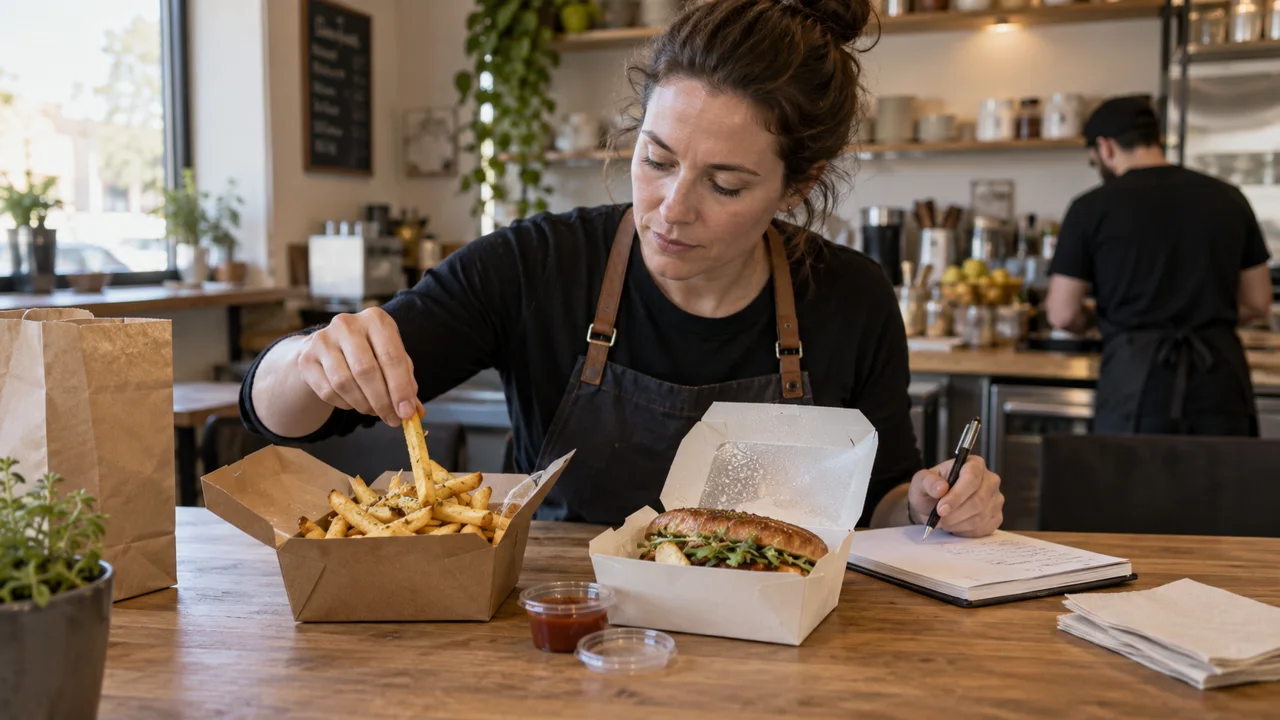
The chips leave the kitchen crisp. The burger looks excellent. Twenty minutes later, the customer opens a damp bag and finds a meal your chef would never put on a table.
That imagined order contains two different experiences: the one you checked at the pass and the one somebody paid to eat.
Takeaway packaging belongs in the product test, not only in the purchasing spreadsheet. The cheapest container is not necessarily the cheapest completed order if it contributes to remakes, complaints or damaged presentation.
Customers are judging the delivered version
In the US National Restaurant Association's 2025 packaging summary, 90% of off-premises customers said they would likely order a wider range if improved packaging maintained dine-in temperature, taste and quality. That is consumer intention, not a measured sales increase from buying better containers.
Use it as a reason to test the journey. Do not turn it into a promise that premium packaging will pay for itself.
Pick the item you are least confident about
Start with a dish that changes noticeably between plating and eating, or one already associated with packaging complaints. Avoid testing only the easiest item because the results look better.
Compare the current pack with one credible alternative. Keep the recipe, portion, preparation method and route comparable. Label the packs so observations do not depend on someone remembering which was which.
Record condition at dispatch and after representative journey times, such as 15 and 30 minutes. These are example testing intervals, not food-safety holding limits. Follow your food-safety procedures for temperature control, transport and disposal. In Australia, FSANZ transport guidance calls for contamination protection and safe temperature control; appearance or a taste test cannot establish safety.
Ask the evaluator to describe what changed, not simply award a star rating.
| Observation | A useful note |
|---|---|
| Presentation | “The sauce moved into the salad compartment.” |
| Texture | “The coating softened before the customer would normally open it.” |
| Package integrity | “The lid loosened during the normal carrying movement.” |
| Customer effort | “The diner needed another plate to assemble the meal.” |
These observations lead to different fixes. Buying a heavier bag will not necessarily solve a sauce problem inside the container.
Change one packaging decision at a time
Potential trials include separating a sauce, isolating hot and cold components, changing a lid, or changing how the bag is loaded. Check that any material is suitable for the intended food and use, using supplier information and applicable local requirements.
Do not change the dish, container and delivery promise at once if you want to learn which adjustment mattered. A practical sequence is to test one likely cause, inspect the result and then move to the next.
Also watch the packing station. A design that works perfectly during a quiet test may be too ambiguous during service. Mark which lid belongs to which container and test whether another staff member can assemble the same order consistently.
The trial is not complete until the team can repeat it.
Put the extra cents into a full calculation
Suppose an alternative pack costs A$0.35 more, and you use it for 600 orders a month. That is A$210 in extra packaging costs.
If the average avoidable remake costs A$15 in incremental food, packing and labour, you would need to avoid 14 remakes a month to offset the extra packaging cost through that saving alone.
These are illustrative, tax-exclusive figures, not supplier prices or predicted results. If your current packaging-related remake count is only four, the remake argument cannot justify the full cost by itself.
You might still choose the pack for product quality or other reasons. Be clear about the decision. Do not add a full refund, a lost sale and the entire replacement order value together as if they were three separate losses without checking how your accounts treat them.
A better container is not a recycling claim
Keep environmental wording as accurate as food descriptions. Before printing disposal instructions, check the specific material, your supplier's evidence and the collection options relevant to your customers.
“Looks like cardboard” is not enough information to write recycling instructions. Nor should a new branded sleeve cover a required label or make an important handling instruction hard to read.
Keep the first trial plain if necessary. Prove the packing method before paying for a large custom print run.
Taste the journey before promoting the menu
Choose one vulnerable dish and one alternative pack this week. Record the cost, the packing effort and the arrival condition. Keep photos of your own test for internal comparison, clearly dated.
Your next delivery promotion should sell the meal that survives the journey, not only the meal that looks good under kitchen lights.
Keep the test record simple
Record the dish, pack, dispatch condition, transport conditions, elapsed time and arrival observations. Include food-safety controls required for your service. A 15- or 30-minute quality comparison is not permission to hold or transport food outside safe conditions.
Make the ordering promise match the meal
Review BizAppMaker’s branded ordering features with the menu and service limits you have tested. Show an accurate description and a clear collection or fulfilment route. Discuss the workflow before promising timing or delivery arrangements. An ordering channel helps guests choose; packaging, transport and food quality remain operational responsibilities.
Explore the app for restaurants, or try the live app demo.